
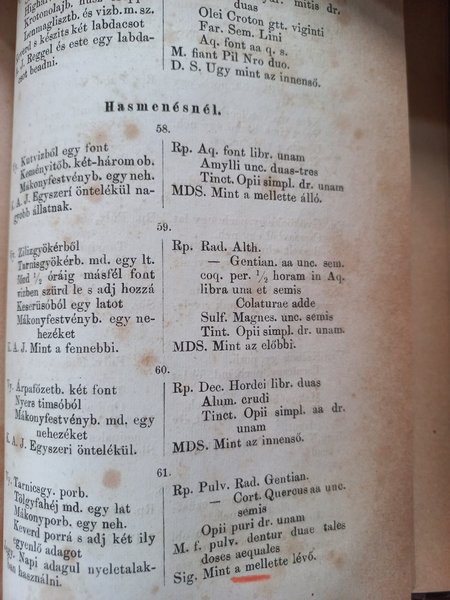
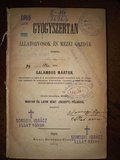
Galambos (1820–1872), a highly interdisciplinary scholar trained in humanities, medicine, surgery and veterinary science, was among the first to bridge scientific knowledge with practical farming needs. His textbook "Pharmacology for Veterinarians and Farmers, accompanied by several hundred Hungarian prescriptions", published in 1871 in Pest (now part of Budapest), is considered the first veterinary pharmacology manual written in Hungarian, making scientific knowledge accessible beyond Latin-speaking elites. Summary by Katalin Gerencsér Ferencné
The 407-page work is remarkably modern in structure. It is divided into a general section covering principles of drug action, dosage, and administration and a special section that classifies medicinal substances according to their effects. Notably, it documents 125 medicinal plant species used in livestock care, grouped by their function, such as digestive support, soothing effects or stimulation.
While some historical uses are now outdated or unsafe, many applications of locally available medicinal plants align with current knowledge. The work underlines that phytotherapy in animal health is not a new trend, but a long-standing practice. Revisiting such knowledge can support today's efforts to develop sustainable, evidence-based alternatives in veterinary medicine.
 tippen und dann zum Befehl zum Home-Bildschirm hinzufügen nach unten scrollen.